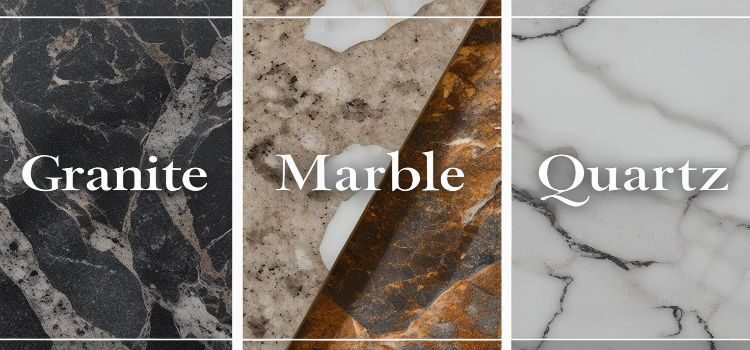
If you have started planning a kitchen renovation or building a new one in 2025, the question of which countertop material to choose has crossed your mind more than once. Your choice will impact daily usability, maintenance, long-term durability, and resale value.
The three most famous options today: marble, quartz, and granite, each bring their own set of pros and cons. From aesthetics to functionality to cost, the decision is not easy. That is why this guide breaks it down in simple terms so you can make the best decision for your kitchen, lifestyle, and budget.
Understanding the Basics
Knowing the basics helps us understand what exactly we are dealing with. All three, marble, quartz, and granite, are used for kitchen countertops; their origin, structure, and qualities are very different.
1. Marble
Marble is a rock that has been known for centuries, in kitchens, architecture, sculptures, and monuments. It is formed when limestone is subjected to high temperatures and pressure deep within the earth. Over time, this process recrystallizes the minerals and gives marble its original veining and smooth texture.
Marble has its own elegance. It has that soft, natural shine like it is glowing from inside. The veins that run through each slab are unique, and no two pieces are the same. That is why you will often find it in kitchens or luxury areas where design takes the focus.
Marble is also very soft compared to other stones. It is more porous and reacts to acidic substances, which means it can stain if not maintained properly.
2. Quartz
Quartz is not mined in solid slabs like marble or granite. Instead, it is an engineered material. It starts with natural quartz crystals, which are then ground up and combined with polymer resins, pigments, and glass or metal flecks.
The result is a slab that looks sleek and modern, with consistent coloring and patterning. What’s great about quartz is its non-porous surface. That means it won’t absorb liquids, making it highly resistant to staining from things like wine, coffee, or oils. It also does not need to be sealed
In terms of performance, quartz is very durable. It is good for everyday use, scratches, and minor impacts.
3. Granite
Granite is an igneous rock, formed when molten magma cools and solidifies underground over millions of years. It’s composed mainly of quartz, feldspar, and mica, minerals that give it strength and its speckled appearance.
Every piece of granite is cut straight from the earth in large blocks, then sliced and polished into countertop slabs. Because of its natural origin, no two granite slabs are ever identical. Some are loaded with bold, dramatic patterns; others have subtle, uniform flecks.
Granite has a reputation for toughness. It’s very hard and resistant to heat, making it a favorite among serious home cooks. It can take a hot pot directly from the stove, no problem. That said, it still needs to be sealed to prevent stains and moisture penetration. And while it’s durable, it can chip at the edges if hit hard enough.
Aesthetics: Which One Looks Best?
When it comes to kitchen design, visual appeal is often the first thing people think about. And honestly, it’s fair. Your countertop takes up a huge portion of the kitchen space, both physically and visually, so whatever you choose is going to stand out. That’s why it’s important to think beyond trends and pick something that fits your personal taste and the style of your home.
Let’s take a look at how marble, quartz, and granite are different in terms of looks.
1. Marble: Timeless and Graceful
Marble has this classic charm that’s hard to ignore. It’s the kind of material you see in old European palaces or luxury hotels, and yet it still feels fresh and elegant in modern homes. The natural veining that runs through marble isn’t just beautiful, it tells a story. Each slab is completely unique, with flowing lines and soft contrasts that give it an almost painterly quality.
White marbles like White Dunes and Brown Fantasy are incredibly popular for kitchens, especially if you’re leaning toward a crisp, clean design. But marble comes in more than just white, you can find subtle greys, greens, even pinkish hues depending on the origin.
If you’re going for a high-end, traditional, or timeless kitchen, marble might be the material that delivers beauty at its best.
2. Quartz: Sleek, Polished, and Customizable
Quartz is all about consistency and control. Since it’s engineered, you get more options when it comes to color, finish, and design. Want something pure white without a single flaw, quartz can do that. Looking for a soft grey with gentle veins to mimic marble, but without the maintenance, that is also possible.
It fits beautifully into contemporary and minimalist kitchen designs. Because it’s man-made, you can get exactly what you’re looking for, whether it’s a cool concrete finish, a high-gloss surface, or even something that sparkles a bit under the light. And the best part? What you see in the sample is almost exactly what you’ll get in your slab, no surprises.
If uniformity and clean lines are your thing, quartz is made for you.
3. Granite: Natural and Earthy with a Wild Streak
Now, granite is a bit of a wild card, and that is a part of its charm. Because it’s 100% natural and formed by geological processes over millions of years, every piece has its own personality. Some granite slabs are full of bold speckles and swirls, while others are more subdued and uniform.
The natural minerals in granite give it its iconic speckled look, with deeper tones like browns, blacks, greens, and blues being quite common. It’s a great fit for rustic, country-style, or transitional kitchens where you want something grounded, organic, and a little bit unpredictable.
Granite’s aesthetic is less “polished perfection” and more “rugged authenticity.” If you love the idea of having a one-of-a-kind piece of the Earth in your home, granite is hard to beat.
Which One Should You Choose?
- If you want timeless beauty that never goes out of style: Choose marble.
- If you’re into sleek lines and no-fuss design uniformity: Go for quartz.
- If you love nature and want something with personality: Granite is for you.
Aesthetic preference is deeply personal. But knowing what each material offers visually can help you narrow things down, especially if you’re designing around specific cabinetry, lighting, or backsplash choices.
Durability
Marble is more porous and softer, making it prone to scratches, stains, and etching from acids (like lemon juice or vinegar). It ages beautifully, but only if you’re okay with a bit of patina. Granite is harder and more resistant to chips and heat. It still requires sealing, but generally handles wear and tear much better than marble.
Quartz is very durable. As it is engineered, it doesn’t need sealing and is highly resistant to stains, scratches, and heat. However, it can discolor under direct sunlight and may crack under extreme heat, so always use a trivet.
In Short:
- Best for durability: Quartz
- Best for heat resistance: Granite
- Least durable (but most beautiful): Marble
Maintenance: Which Is Easier to Care For?
Let’s be honest, nobody wants to spend hours worrying about their countertops.
- Marble: Needs regular sealing, can etch easily, and is sensitive to acidic cleaners. Requires the most babysitting.
- Granite: Needs periodic sealing but is generally fuss-free.
- Quartz: Just wipe and go. No sealing. No drama.
Cost Comparison: Affordable Stone Countertops
Cost depends on availability, design and installation. While granite and quartz can sometimes overlap in pricing, marble generally falls on the higher side, especially rare varieties. But with suppliers like Madhav Marbles Granite Ltd., you can source quality slabs at competitive rates.
Quartz Kitchen Countertop Trends
Quartz continues to dominate in modern kitchens because of its blend of beauty and practicality.
Top trends this year include:
- Matte finishes instead of high gloss
- Soft whites with light veining (marble look-alikes)
- Integrated sinks and backsplashes
- Earthy tones like taupe, sand, and light greys
Quartz lets you have a high-end look without high-maintenance care, which is a big win for busy homeowners.
Sustainability and Health Considerations
More homeowners in 2025 are asking questions beyond design. They want to know if their countertops are eco-friendly and safe.
- Marble and Granite: Natural stones that don’t off-gas or contain harmful VOCs. However, quarrying and transport can have an environmental footprint.
- Quartz: Uses recycled materials and produces less waste during manufacturing. But resins used in some cheaper versions may contain chemicals. Choose a certified supplier to avoid issues.
Best Countertop Material 2025: Final Comparison Table
| Feature | Marble | Quartz | Granite |
| Appearance | Elegant, timeless | Consistent, customizable | Natural, bold |
| Durability | Low | High | Medium-High |
| Maintenance | High | Low | Medium |
| Heat Resistance | Moderate | Moderate | High |
| Scratch Resistance | Low | High | High |
| Stain Resistance | Low | High | Medium |
| Cost (India, 2025 avg) | High | Medium-High | Medium |
| Best For | Luxury kitchens | Modern families | Natural-themed homes |
Is Granite Better Than Quartz?
Here’s the thing: granite and quartz are both strong contenders. Granite has unbeatable heat resistance and a raw, natural vibe. Quartz offers uniformity, easier maintenance, and a wide variety of designs.
If you’re asking, “Is granite better than quartz?” The answer is, it depends. If you’re a home chef dealing with hot pans all day, granite is a safe bet. If you want worry-free upkeep with a contemporary touch, quartz might be your kitchen soulmate.
Where Does Marble Still Win?
Despite its upkeep, marble continues to attract designers and architects in 2025 for one simple reason: nothing looks like real marble.
It’s a statement piece. If you’re designing a luxury kitchen, especially one meant to impress or raise property value, a marble island or backsplash can do wonders.
Many homeowners use marble strategically, on an accent countertop or a wall, while relying on quartz or granite for high-traffic areas.
Mixing Stones
One overlooked trend is mixing materials. Why stick to one when you can combine?
- Use marble on your island for drama
- Choose quartz for the countertops you use every day
- Add a touch of granite for side counters or wet bars
With the right eye, this mix-and-match method offers a unique, designer look that’s both practical and stylish.
What Madhav Marbles Granite Ltd. Recommends
At Madhav Marbles Granite Ltd., clients often ask for a balance of beauty, resilience, and price. And in 2025, here’s what continues to work well:
- For white kitchens: Quartz in marble-inspired patterns
- For rustic aesthetics: Ivory brown or Mist Black granite with textured finishes
- For luxury accents: Classic white marble with soft veining
- For budget-friendly elegance: Engineered quartz in light tones with a matte finish
Our wide range of slabs ensures you’re not limited in choices, even if you are remodeling a home or outfitting a commercial kitchen.
Final Thoughts
There’s no one-size-fits-all answer. But if you’re still confused, here’s a quick decision guide:
- You love cooking and want easy care: Go for quartz
- You appreciate natural, raw beauty and don’t mind a bit of upkeep: Pick granite
- You’re designing your dream kitchen and want it to shine: Say yes to marble
Whatever you pick, make sure you buy from a supplier who knows their stones and offers full support with cutting, polishing, and shipping, like Madhav Marbles Granite Ltd.
Explore our curated collection of quartz, granite, and marble slabs. You can also request guidance based on your space, layout, and lifestyle.
Because your kitchen deserves more than just a pretty surface, it deserves the right foundation. Contact us for more information.